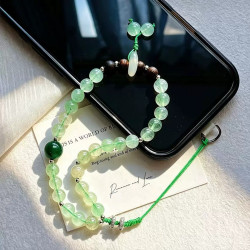
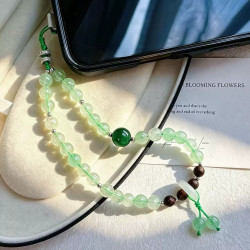
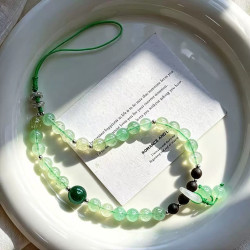
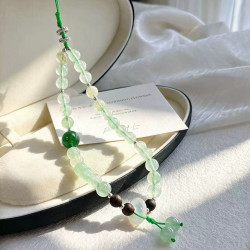
Strawberry Quartz
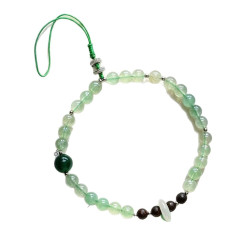
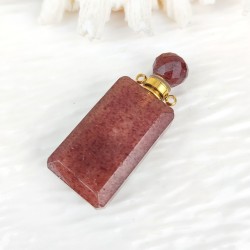
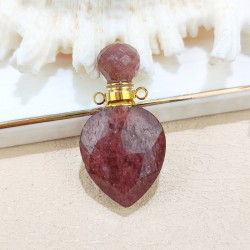
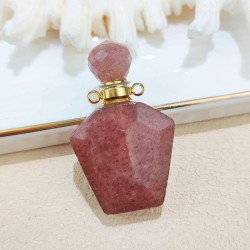
Strawberry quartz is clear quartz scattered with tiny red inclusions — lepidocrocite and hematite flecks suspended in the crystal like seeds in flesh, which is exactly where the name comes from. It is a quartz for people who find rose quartz too flat: the color moves inside the stone instead of sitting evenly across it. Below you will find our strawberry quartz range of beads and pendants.
What Strawberry Quartz Actually Is
The host is ordinary quartz — silicon dioxide, Mohs 7, specific gravity 2.65 — and the strawberry color is created by microscopic platelets of iron-bearing minerals, principally lepidocrocite and hematite, that grew in or settled into the quartz as it formed. Under magnification the inclusions resolve into distinct red specks and threads; to the eye they blend into a soft warm pink. Notable producing localities include Russia, Mexico and iron-rich pockets of Brazilian pegmatites, and the material is genuinely scarce relative to its demand — which is why dyed substitutes flood the market.
The stone should not be confused with rose quartz, which is milky and nearly opaque, nor with "cherry quartz," a red glass composite with swirled color and no inclusions at all.
Strawberry Quartz Meaning and Association
In crystal tradition strawberry quartz carries the heart-chakra association of rose quartz with an added symbolism of joy and gratitude — the "sweetness" reading comes from the seed-and-flesh look, and the stone is often described as a gentler heart stone for people who find deeper pinks too sentimental. These are cultural associations rather than scientific claims, but they explain why it is chosen as an affection gift more often than a self-purchase. To compare the classic, see the rose quartz collection; to browse by purpose, start at the crystals by intention hub.
How to Wear and Use Strawberry Quartz
Strawberry quartz rewards light: beads and faceted forms that catch sun show the red seed-specks glinting, while the same stone in dim rooms reads as simple pink. Wear it as the single warm accent against linen, denim or gray. As a Mohs 7 quartz it handles daily wear with no special restrictions — bead bracelets, pendants and even rings all serve, and the inclusions are internal, so nothing on the surface can wear away.
Caring for Strawberry Quartz
Standard quartz care covers everything: warm water, mild soap, soft brush around the drill holes, dry with microfiber. Ultrasonic cleaning is safe for solid beads. The inclusions cannot be washed out or faded by light — iron oxides are as light-stable as the quartz around them — so wear it outdoors freely. Storage discipline is the only rule that matters: strawberry quartz will scratch anything softer than Mohs 7 in a shared pouch, so give it its own compartment and keep it away from jade, calcite and pearls.
How to Tell Natural from Dyed
This is the critical authenticity question for strawberry quartz, because dyed quartz and dyed glass are everywhere. Natural color lives inside: under a loupe the red resolves into distinct specks and threads suspended within the quartz, and the overall tone stays consistent from every angle. Dye lives in cracks: loupe inspection shows color pooled along fractures and concentrated at drill holes, where dye entered; a damp white cloth rubbed on a dyed bead often picks up pink, and the color of dyed strands looks blotchy when held to strong light. Any "strawberry quartz" priced at glass-bead levels, with perfectly even candy-pink color and no visible specks, should be assumed dyed or glass until proven otherwise.