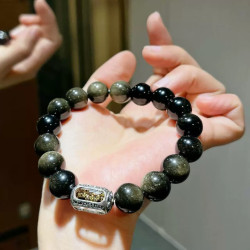
Golden Obsidian
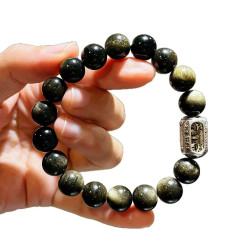
Golden obsidian is natural volcanic glass that flashes a band of soft gold as it turns — not a coating, not a dye, but microscopic mineral layers inside the stone itself. As a glass it forms in one geological instant, which makes it the only common jewelry stone younger than the human who wears it. Below you will find our golden obsidian range of roll-bead bracelets and pendants.
What Golden Obsidian Actually Is
When silica-rich lava cools too fast for crystals to organize, the result is obsidian — an amorphous glass, Mohs 5–5.5, specific gravity about 2.4, fracture edges sharper than surgical steel. In golden obsidian, sub-microscopic particles of magnetite and hematite settled in parallel bands while the glass was still flowing. Light bouncing between those aligned layers produces a rolling golden sheen that sits beneath the surface and moves as the stone tilts — the optical signature that separates genuine sheen obsidian from anything painted.
Most golden obsidian in jewelry comes from Mexico and the western United States, where rhyolite flows produced glass with layered inclusion zones. The related varieties are silver sheen (the same effect in silver-white) and rainbow obsidian (thin-film iridescence in curved bands).
Golden Obsidian Meaning and Association
In crystal tradition golden obsidian combines obsidian's protective association with the abundance and willpower symbolism of the gold color — a stone carried to turn opportunity into action, linked to the root and sacral chakras. These are cultural associations rather than scientific claims, but they explain why sheen obsidians are popular as daily-wear pieces for people who like black stones with a difference. Compare the silver-white sibling in our silver obsidian collection; to browse by purpose, start at the crystals by intention hub.
How to Wear and Use Golden Obsidian
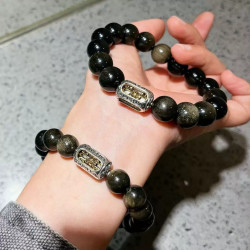
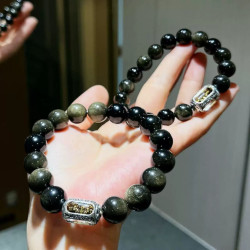
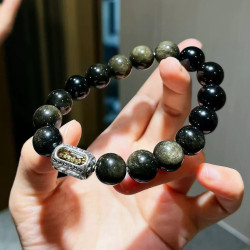
The classic form is the rolling bead — a faceted barrel that catches light from many angles and shows the sheen band shifting as the wrist moves. Golden obsidian wears warm despite being black-based glass: the gold flash softens it for day wear. Weight is a signature — genuine obsidian beads feel notably lighter than the same-sized mineral beads, which surprises people expecting stone heft. Wear it solo or with silver; the sheen gets lost beside busy polished stones.
Caring for Golden Obsidian
As a Mohs 5–5.5 glass, obsidian takes a knock less gracefully than quartz: protect it from hard drops and from sharing a pocket with keys or other beads. Clean with warm water and mild soap — never ultrasonic or steam — and dry with a microfiber cloth, which restores the polish better than any compound. The sheen is internal and cannot be washed or worn off; only a scratch through the surface layer will interrupt it. Store pieces separately so harder stones do not leave hairline scuffs in the glass.
How to Tell Golden Obsidian from Imitations
The common substitutes are goldstone (copper-flecked glass, which glitters with even, round sparkles rather than a moving band of sheen) and resin composites. Genuine sheen obsidian's gold band moves when the stone rotates and sits below the surface like light under ice; coatings sit on top and look flat from the side. Check the drill holes of beads — real obsidian chips conchoidally with curved glassy fracture faces, while resin shows waxy, dull hole edges. Temperature helps too: glass and resin warm quickly to the touch, obsidian a touch slower, and obsidian's fracture is unmistakably glassy under a loupe.