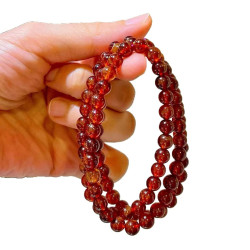
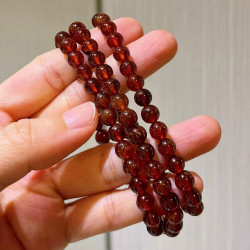
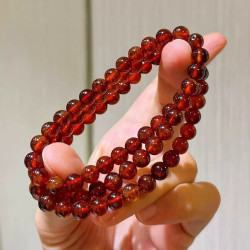
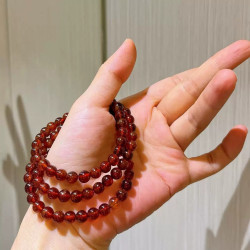
Garnet
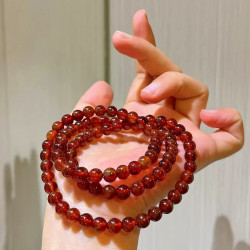
Garnet is a family of minerals rather than a single stone — deep red almandine is the classic, but the group also spans orange spessartine, green demantoid and pink rhodolite. The reds that dominate jewelry take a polish like wet wine and have been worn since the Bronze Age. Below you will find our garnet range of bead bracelets, strands and pendants in natural red tones.
What Garnet Actually Is
Garnets are nesosilicates with a shared cubic crystal structure and no cleavage — which is why they survive wear so well despite a hardness of only 6.5–7.5 depending on the species. The name comes from granatus, "seed-like", for the way crystals resemble pomegranate seeds in both color and round-dodecahedral shape. Almandine, the iron-aluminum garnet in most red jewelry, comes from India, Sri Lanka and East Africa. Victorian jewelry loved it: the carbuncle-cut domes of that era were garnet, and the huge Bohemian garnet industry of the 1800s set the small wine-red stones in dense clusters.
Garnet holds January in the modern birthstone list, and in the Victorian "language of stones" it stood for constancy — a safe way to promise what a diamond was too expensive to say.
Garnet Meaning and Association
In crystal tradition garnet is the vitality stone — warm, energizing, associated with persistence through long effort and linked to the root chakra. Travelers' garnet is an old protective motif, and the red family carries the usual heart-and-fire symbolism across many cultures. These are cultural associations rather than scientific claims, but they explain why garnet is a working stone, worn daily rather than on occasions. To pair it with another warm daily-wear stone, see the tiger's eye collection; to browse by purpose, start at the crystals by intention hub.
How to Wear and Use Garnet
Almandine's deep red reads formal against silver and rich against bronze, but its best trick is the strand: small garnet beads built up in layers look far more expensive than their individual cost suggests. Wear garnet in any form — its lack of cleavage means bracelets and rings both survive. Faceted garnet shows its color best under warm indoor light, where the stone goes from dark red to glowing; in daylight it reads darker, so choose strand sizes accordingly.
Caring for Garnet
Warm water, mild soap, a soft brush at the drill holes, and a dry polish with microfiber — the standard silicate routine. Ultrasonic cleaning is safe for most almandine; keep fractured stones and any strand strung on silk out of the machine. Garnet's 6.5–7.5 hardness means quartz will abrade it in shared storage, so keep it in its own pouch. The color is completely light-stable — no fading risk, no treatment needed, which is part of why honest garnet has been a jeweler's staple for five hundred years.
How to Tell Natural Garnet from Imitations
Garnet is rarely treated — its color is naturally deep, so there is little to enhance. The imitations to know are red glass and composite "garnet doublets" (a garnet top fused to glass). Glass shows bubbles and mold seams under a loupe; garnet shows angular crystal outlines, occasional inclusions of mica or rutile, and a distinctly heavier feel than glass (specific gravity 4 versus glass's 2.5). A strand priced far below red-glass costume jewelry should raise the opposite suspicion — composite or thin garnet laminates — which the loupe catches at the drill hole where layers separate.
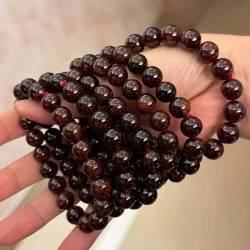
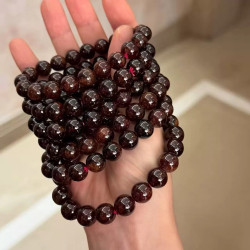
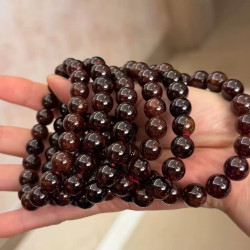
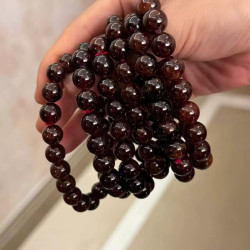
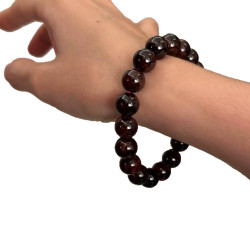
Garnet 10mm Bracelet for Spiritual Growth