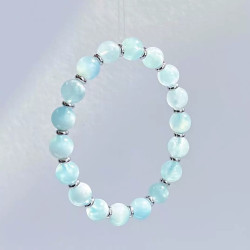
Aquamarine
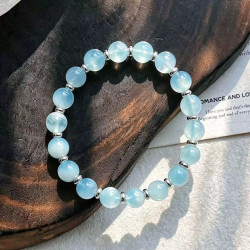
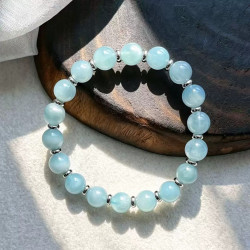
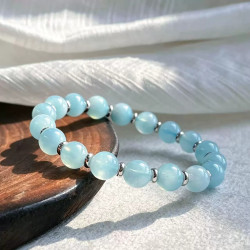
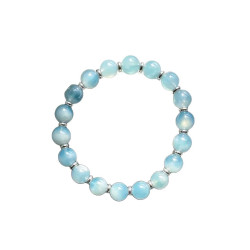
Aquamarine is the blue member of the beryl family — cousin to emerald, harder than quartz, and named for sea water by people who depended on it. Its color runs from pale ice blue to saturated marine blue, with the deeper tones carrying the value. Below you will find our aquamarine range of bracelets and pendants in natural, untreated-style pastels.
What Aquamarine Actually Is
Beryl is beryllium aluminum silicate, Mohs 7.5–8 — hard enough that a well-cut stone keeps its polish for a lifetime. Aquamarine's blue comes from trace iron in the crystal structure; the greener the stone, the higher the iron ratio toward emerald's chemistry. Fine material comes from Brazil (Minas Gerais), Nigeria and Madagascar, where pegmatite cavities grow six-sided crystals that can reach sizes measured in kilograms. Most gem aquamarine on the market is gently heated to shift the subtle green tint toward pure blue — an accepted, stable treatment the trade discloses routinely.
The stone's reputation is older than its chemistry: Roman sailors carried it as a talisman against drowning, and medieval lapidaries recommended it for calming disputes. "Aquamarine" entered formal birthstone lists in 1912 and holds March.
Aquamarine Meaning and Association
In crystal tradition aquamarine is the stone of calm courage — steady nerve rather than aggressive drive — and of clear communication, which is why it is linked to the throat chakra. The sailor's protective association carries into a modern reading of the stone as a traveler's piece. These are cultural associations rather than scientific claims, but they explain why aquamarine is a common gift for departures, new jobs and new homes. To pair it with its deep-blue cousin, see the lapis lazuli collection; to browse by purpose, start at the crystals by intention hub.
How to Wear and Use Aquamarine
Aquamarine's pastel depth rewards larger stones — a faceted bead or a shaped pendant shows more color than a tiny one. Wear it against white, gray or denim to keep the blue reading as blue; against green fabrics it can look gray by comparison. As a March birthstone it carries gift duty, and as a hard stone it handles daily wear comfortably. The one structural caution: beryl has one direction of cleavage, so a hard blow to a corner can split a faceted stone even at Mohs 7.5–8 — bracelets get knocked, pendants do not.
Caring for Aquamarine
Warm water with mild soap and a soft brush is the complete routine. Ultrasonic cleaning is safe for clean, fracture-free stones; steam cleaning is riskier because of the cleavage. Avoid ammonia-based dips and avoid harsh knocks to corners. The color is stable under light — unlike kunzite or smoky quartz, aquamarine does not fade in sunlight — so wear it outdoors freely. Store it in its own compartment so harder stones do not scratch its polish.
How to Tell Natural from Imitation
The most common stand-in is blue topaz — itself usually treated — which is typically more saturated blue at a lower price. Beryl's tell is its lower refraction and its hexagonal crystal habit: look for six-sided outlines in beads or flat faces meeting at 120 degrees. Blue glass imitation shows bubbles and mold seams under a loupe. Check the drill holes on a bead strand: dyed or coated imitations concentrate color at the hole's edge, while genuine beryl shows the same blue through and through.