Green Aventurine
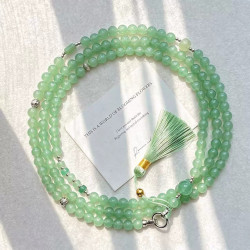
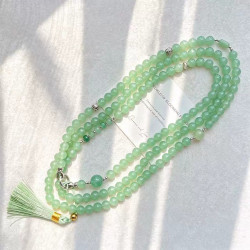
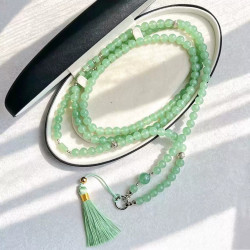
Green aventurine is quartz with a work ethic — a translucent green stone whose soft shimmer, called aventurescence, comes from tiny plate-like mineral inclusions rather than any dye. At Mohs 7 it is hard enough for daily-wear bracelets, and its color, somewhere between moss and sea glass, suits almost every skin tone. Below you will find our green aventurine range of bracelets, beads and pendants.
What Green Aventurine Actually Is
Chemically it is common quartz (silicon dioxide, Mohs 7, specific gravity 2.65), colored green by flakes of fuchsite, a chromium-bearing mica — the same element that gives emerald its green. Those flakes, laid flat as the crystal grew, catch light and produce the stone's signature glitter when it is turned. Most material on the market comes from India, where it is often traded as "Indian jade" — a nickname only, since jade is an entirely different mineral.
The name aventurine has a precise origin: in the eighteenth century, Venetian glassmakers spilled copper filings into a melt by accident — a ventura, "by chance" — and the resulting spangled glass was named first. The natural stone that resembles it took the name later, which is why the most common imitation of green aventurine is, fittingly, that same spangled glass.
Green Aventurine Meaning and Association
In crystal tradition green aventurine is the stone of opportunity and renewal — the piece people reach for before a first day, a pitch, or any situation where luck has to meet preparation. It is most commonly linked to the heart chakra. These are cultural associations rather than scientific claims, but they explain why aventurine is often given as a beginning-of-something gift. For a different take on green-stone luck, compare our jade collection; to browse by purpose, start at the crystals by intention hub.
How to Wear and Use Green Aventurine
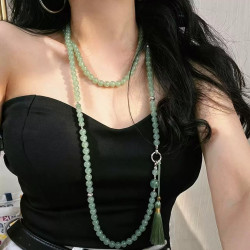
Aventurine wears like the quartz it is: 8 mm bead bracelets are the standard form, and the material's toughness means the same strand can serve for years with nothing more than occasional cleaning. The green reads casual with linen and fresh with silver. If a bracelet will be worn to an interview or a new job, keep the rest of the wrist empty — the stone's soft shimmer reads best without competition, and a single-strand habit is easier to keep than a stacked one.
Caring for Green Aventurine
Quartz rules apply: warm water, mild soap, a soft brush around the drill holes, and a dry microfiber cloth finish. Ultrasonic cleaning is generally safe, though a strand with visible fractures should simply be wiped instead. Avoid prolonged direct sunlight — the green comes from inclusions, and long exposure can slowly fade the strongest tones. Store aventurine with softer stones rather than against topaz or diamond, which will scratch it in a shared pouch.
How to Tell Natural from Imitation
Spangled green glass is the imitation to beat. Glass shows round bubbles under a loupe; aventurine shows angular mineral flakes, faint growth banding, and the slight unevenness natural quartz always carries. Dyed quartz is the second lookalike — turn a bead and look for color pooling in cracks, especially near the drill hole. A genuine strand feels cool and stays cool a moment longer than glass at cheek temperature, and its glitter is directional, appearing and disappearing as the stone moves rather than shining evenly from everywhere.
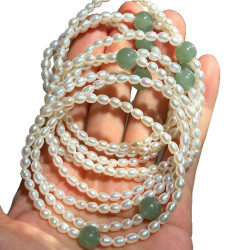
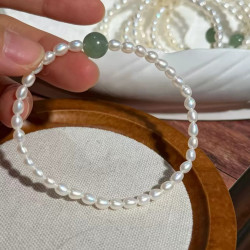
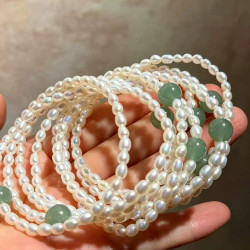
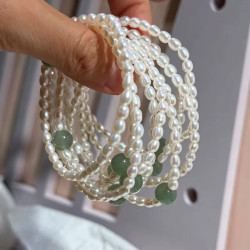
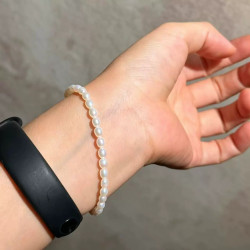
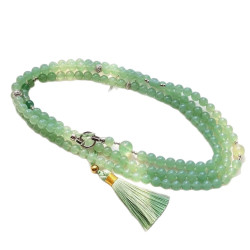
Green Aventurine 4mm Bracelet for Wealth & Abundance