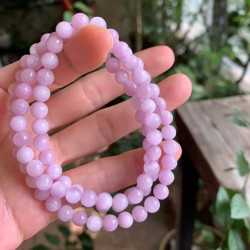
Kunzite
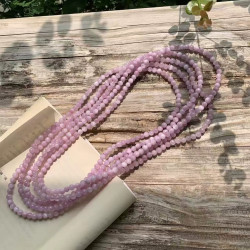
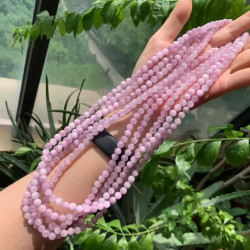
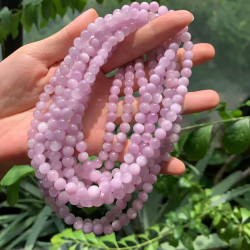
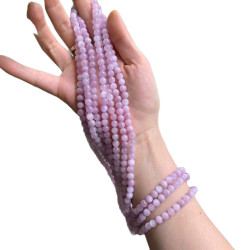
Kunzite is the pink member of the spodumene family — a lithium mineral whose color runs from blush to soft lilac, and which has two habits worth knowing before you buy: it fades under prolonged bright light, and it cleaves cleanly in two directions, so the form it is mounted in matters. Below you will find our kunzite range of pendants and beaded pieces chosen for daily-wear safety.
What Kunzite Actually Is
Spodumene is a lithium aluminum silicate, Mohs 6.5–7, and kunzite is its manganese-tinted pink variety. Fine crystals come from Afghanistan, Brazil, Madagascar and California — the San Diego County pegmatites produced some of the museum-grade material. The stone was formally described in 1902 and named for George Frederick Kunz, Tiffany's chief gemologist and the most famous American gem expert of his era, after he identified cut material from a California deposit as a new variety rather than hiddenite.
Kunzite is strongly pleochroic — it shows different pinks from different crystal directions — so a well-cut stone is oriented deliberately to present its richest face. The same crystal habit gives kunzite its one wearing caution: perfect cleavage in two directions, which is why a sharp blow to a corner can part a faceted stone cleanly where a quartz would only chip.
Kunzite Meaning and Association
In crystal tradition kunzite is a heart stone — associated with openness, emotional recovery, and the ability to receive affection rather than only give it, linked to the heart chakra and higher. The trade nickname "evening stone" is about physics, not poetry: kunzite's pink shows best after sunset, partly because prolonged strong light actually fades the color. These are cultural associations rather than scientific claims, but they shape how the stone is worn. To pair it with the classic heart stone, see the rose quartz collection; to browse by purpose, start at the crystals by intention hub.
How to Wear and Use Kunzite
Pendants and earrings are kunzite's natural forms — they protect the cleavage, show the pleochroic color, and sit under indoor evening light where the stone looks its best. Bead strands are for gentle wear. Because sunlight fades kunzite over months of exposure, wear it freely but store it dark: a jewelry box rather than a windowsill or a sunlit dresser top. The pink deepens slightly toward lilac in cooler evening light, which is when the stone earns its nickname.
Caring for Kunzite
Warm water, mild soap, quick rinse, soft dry cloth — and nothing else. No ultrasonic and no steam, both of which can cleave a stone along its internal planes. Avoid knocks to corners and edges; remove kunzite before sports, cleaning with chemicals, or any task that swings a hand against hard objects. The cleavage also means kunzite should never be worn in a ring that does the dishes. Stored dark, dry and alone, a kunzite keeps its color indefinitely — the fading horror stories all start with years on a bright display shelf.
How to Tell Natural from Treated Kunzite
Natural kunzite color is soft, directional and slightly uneven — the pleochroism means tilting the stone shifts the tone, an effect dyes cannot reproduce. Some kunzite is irradiated to deepen pale pink, a treatment the trade discloses when asked; irradiated stones tend toward uniform saturation. Pink glass imitation shows bubbles and even color; dyed quartz shows color pooled in cracks. A reputable seller states origin and treatment plainly — kunzite has been documented long enough that provenance is normal to expect.