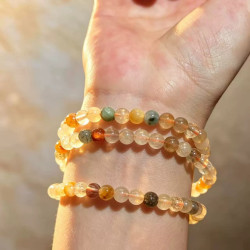
Rutilated Quartz
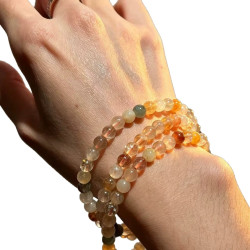
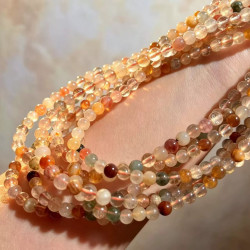
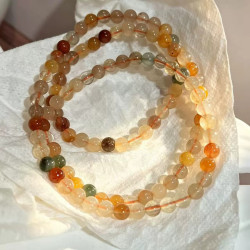
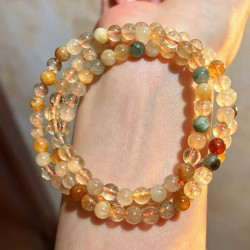
Rutilated quartz is clear quartz with golden needles of rutile frozen inside — one mineral trapped by another during growth, like a photograph of a geological moment. Collectors call it Venus's hair stone, and no two pieces carry the same pattern: parallel sheaves, criss-cross nets, radiating stars. Below you will find our rutilated quartz range of beads and pendants.
What Rutilated Quartz Actually Is
The host is ordinary crystalline quartz — silicon dioxide, Mohs 7, the most durable everyday jewelry mineral. The needles are rutile, titanium dioxide, crystallized as slender rods while the quartz grew around them. Rutile ranks about 6–6.5 alone, but inside quartz the needles are protected by the harder host, and the composite stone wears as quartz. Brazil supplies most gem-grade rutilated quartz, from pegmatite pockets where titanium-rich fluids circulated through silica-rich cavities.
The needles form in patterns lapidaries describe by name: parallel "rutilated" bundles, dense sagenite nets, starbursts radiating from a single point, and the prized "angel hair" sprays fine enough to look like silk threads suspended in glass. These are natural growth features — every pattern is permanent, sealed inside the quartz forever.
Rutilated Quartz Meaning and Association
In crystal tradition rutilated quartz combines clear quartz's amplification association with the directional, energizing symbolism of the golden needles — a stone carried for clarity of intent and momentum, linked to the solar plexus and crown chakras. Old lapidary lore treated golden rutile as "locks of the goddess". These are cultural associations rather than scientific claims, but they explain why the stone is often chosen for turning-point gifts. To see the pure host mineral, browse the clear quartz collection; to browse by purpose, start at the crystals by intention hub.
How to Wear and Use Rutilated Quartz
The pattern is the product, so choose by the needles rather than by weight or cut: a bead with one dramatic starburst outperforms a dozen quiet ones. Faceted beads show needles in motion as the wrist turns; a pendant lit from behind — worn on a fine chain against bare skin — turns the stone into a small lantern. Rutilated quartz layers comfortably with gold tones, which echo the rutile color. Like all quartz it is a daily-wear stone with no fragile habits.
Caring for Rutilated Quartz
Full quartz routine: warm water, mild soap, soft brush at the drill holes, microfiber to finish. Ultrasonic cleaning is safe for solid beads. The needles cannot be washed out, scratched off or dislodged — they are inside the stone, so the only real maintenance is the polish of the quartz surface itself. Keep the piece away from harder stones in storage to avoid hairline scratches, and it will look the same in fifty years, since neither member of the composite fades, clouds or ages.
How to Tell Natural Rutilated Quartz from Imitations
The imitation to know is goldstone — man-made glass with copper glitter, often sold to the unwary as a similar effect. Goldstone sparkles with thousands of even, triangular copper flecks visible as distinct particles; natural rutile needles look like fine hair or threads, continuous, curved at the ends and organized in bundles. Glass also shows bubbles and warms quickly to the touch, while quartz stays cool and shows its hexagonal growth character. Any "rutilated" stone priced like costume glass, with perfectly even sparkle and no thread structure, is goldstone — attractive, but not this stone.