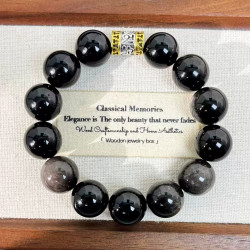
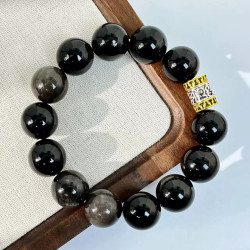
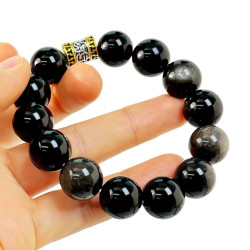
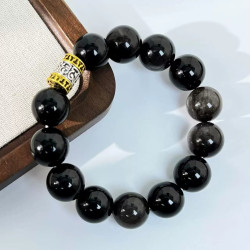
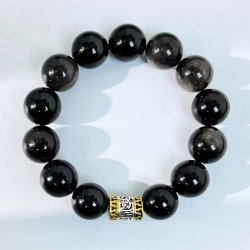
Silver Obsidian
Silver obsidian is black volcanic glass carrying a band of silver-blue light that seems to sit beneath the surface — a stone that looks plain until it moves. Like all obsidian it is natural glass younger than most fossils, formed when lava cooled faster than crystals could form. Below you will find our silver obsidian range of bracelets and pendants.
What Silver Obsidian Actually Is
Obsidian is silica-rich lava frozen as amorphous glass — Mohs 5–5.5, specific gravity near 2.4, with no crystal structure and therefore no cleavage, breaking with the curved conchoidal fracture Stone Age knappers relied on. In silver sheen obsidian, sub-microscopic particles of magnetite settled into parallel planes while the glass was still flowing. Those aligned planes reflect light as a single silver-blue band that moves across the stone as your viewing angle changes — an effect physically impossible to fake with a surface coating.
Major sources are Mexico and the western United States. The sheen obsidian family includes golden (warm gold band), rainbow (thin-film colors in curved layers) and silver — all the same glass, distinguished only by the size, spacing and chemistry of their inclusion planes.
Silver Obsidian Meaning and Association
In crystal tradition obsidian is the truth-and-protection stone — associated with seeing clearly, cutting through self-deception, and holding steady boundaries. The silver sheen variety adds the symbolism of reflection and cool insight, and it is linked to the root chakra with a secondary association to the third eye. These are cultural associations rather than scientific claims, but they explain why obsidian pieces are often chosen as anchor stones for difficult transitions. To see the warm-toned sibling, browse the golden obsidian collection; to browse by purpose, start at the crystals by intention hub.
How to Wear and Use Silver Obsidian
Silver obsidian is the quietest of the sheen obsidians — a working stone that reads matte black until it catches light, when the silver band appears like moonlight on water. Wear it with silver settings or alone; it flatters cool-toned wardrobes and gives evening black a detail worth noticing. Bead bracelets show the sheen best because the wrist keeps the stone moving. Like all obsidian it is light for its size — the glass density means a strand feels less hefty than mineral beads of the same diameter.
Caring for Silver Obsidian
Glass rules apply. Warm water and mild soap, dried with microfiber, keeps the polish without any compounds. No ultrasonic, no steam, no harsh chemicals. The real risk is mechanical: at Mohs 5–5.5, obsidian scratches against quartz and chips against tile, so take bracelets off before workouts, gardening and kitchen work with hard surfaces. The silver sheen is internal and permanent — only a scratch deep enough to cross the inclusion planes will interrupt it. Store each obsidian piece in its own pouch.
How to Tell Silver Obsidian from Imitations
The common imitation is coated or foil-backed black glass, and the test is motion: a genuine sheen band glides beneath the surface as the stone rotates, while a coating stays fixed relative to the surface and looks flat from an angle. Under a loupe, real obsidian shows the glassy conchoidal fracture at chip edges and at drill holes — curved, shell-like, sharp. Resin fakes show waxy dull edges. Black tourmaline and black onyx are sometimes confused with plain obsidian, but neither shows any sheen band at any angle, and both feel distinctly heavier in the hand than glass.