The Talents You Keep Forgetting: Reading Trines and Sextiles in Your Birth Chart This October
By Starener Editorial - 21/07/2026 - 0 comments
If you have spent any time with your birth chart, you have probably spent most of that time on the friction. The squares that feel like an inner critic with a megaphone. The oppositions that show up as people who annoy you precisely because they mirror something you refuse to own. Psychological astrology has good reasons to focus there, and we covered both of those conversations in earlier pieces. But there is a quieter half of the chart that most people scroll right past: the trines and sextiles, the aspects of ease, talent, and flow.
Practitioners often notice a strange pattern here. The challenging aspects get discussed, journaled about, and worked on for years. The flowing ones get a shrug. Astrological author Donna Cunningham reportedly observed that when she pointed out the talent a client's sextile described, the reaction was usually a flat little sentence: "Oh, that." The ability felt so natural that it did not register as an ability at all.
This month, consider doing the opposite of what feels urgent. October is a natural checkpoint season, and the two soft aspects below describe resources you already own but may never have inventoried.
Why the Easy Parts of the Chart Are the Hardest to See
Hard aspects produce symptoms: tension, delay, repeated conflicts. Symptoms get attention. Soft aspects produce what feels like personality. If talking to strangers has always been easy for you, you do not say "I have a supportive Mercury-Venus aspect"; you say "I'm a people person." The aspect disappears into the trait.
In psychological astrology, this invisibility matters because the framework treats the chart as a mind map rather than a fixed fate. The flowing connections describe where your psyche cooperates with itself by default. When you can name that cooperation explicitly, you can aim it deliberately instead of letting it leak into whatever your week happens to hand you.
The Trine: A River Running Downhill
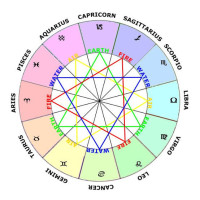
A trine is formed when two planets sit roughly 120 degrees apart, which in practice means they occupy signs of the same element: fire with fire, earth with earth, air with air, water with water. Tradition holds that planets in the same element speak the same language, so their energies combine without translation. The result feels like a river running downhill: motion that happens on its own.
Classic textbook readings make this concrete. Sun trine Jupiter is traditionally kept for natural optimism and the ability to see the big picture even in a hard week. Venus trine Neptune is read as artistic sensitivity and an easy instinct for beauty. Moon trine Mars is described as emotional courage, the kind where feelings and healthy assertiveness simply agree with each other. In each case, the two planetary functions cooperate so smoothly that other people notice the gift before you do.
The element flavors the talent. Fire trines describe enthusiasm and bold action that arrive without self-pep-talks. Earth trines describe practical competence, the person who quietly fixes the thing. Air trines describe intellectual and social ease. Water trines describe intuitive flow and emotional attunement. Many people find that simply identifying which element holds most of their trines explains why certain compliments keep repeating in their lives.
The Sextile: The Door You Have to Knock On
A sextile forms at roughly 60 degrees, connecting compatible but different elements: fire with air, or earth with water. Because the elements differ, the connection is friendly but not automatic. Astrologers often describe the difference this way: if a trine is a river running downhill, a sextile is a well-kept path that you must choose to walk.
That small spark of initiative is the sextile's signature. Saturn sextile Pluto, for example, is traditionally read as the ability to plan and execute major life changes, but only when the person actually takes the first step. Mercury sextile Uranus describes flashes of original thinking that arrive when the mind is given room to wander. The opportunity is real, but it rewards participation rather than waiting.
The Complacency Trap
Here is the caution that serious practitioners attach to soft aspects, and it is worth stating plainly: a chart full of trines is not a better chart. Astrological writer Jeff Mayo noted that a chart rich in trines may show a complacent nature unless the person consciously works with the energy. Gifts that come too easily can stay undeveloped, because nothing forces the question.
Many people find it more useful to flip the framing. The flowing aspects are where you can rest and refuel; the hard aspects are where you grow. Treat your trines and sextiles as platforms, not as sofas. A platform is something you launch from.
A 20-Minute Talent Inventory You Can Do This Month
Step 1: List every trine and sextile you can find
Use any free birth chart tool and scan the aspect grid for the trine and sextile symbols. Do not worry about minor aspects yet. Aim for a simple list, even four or five lines long.
Step 2: Write one sentence per aspect
Turn each pairing into a plain-language talent statement. For example: "Mercury sextile Uranus: I have flashes of original thinking." Or "Moon trine Saturn: people trust me because my calm is consistent." Keep the sentences concrete enough that a friend could recognize you in them.
Step 3: Note the houses involved
The houses tell you where the flow tends to show up: career, relationships, creativity, money, home. A Venus-Jupiter trine in the money houses reads very differently from the same aspect in the houses of friendship. This is where the talent becomes actionable.
Step 4: Choose one talent and practice it for one week
Pick the sentence that made you slightly uncomfortable because it was true. Give that talent one deliberate assignment this week: a conversation, a small project, a favor done in your own style. The point is to convert a taken-for-granted trait into a chosen act.
Step 5: Collect the dismissed compliments
Write down the three compliments you hear most often and wave away. "You make it look so easy" is frequently a trine talking. The record of what others see is often more accurate than your own estimate.
Wearing the Reminder
Practitioners of symbolic jewelry hold that an anchor on the body helps an insight survive past the week it was learned in. If your inventory reveals a fire-element talent you want to aim more deliberately, a warm red thread on the wrist is a traditional attention cue; earth talents pair with grounding tones, air with silver and light blues, water with deep sea colors. A simple piece from Starener's red string and crystal collection can serve as that daily cue: not a promise of luck, but a physical bookmark for the talent you finally decided to use.
Frequently Asked Questions
Are trines always good news?
They describe ease, not virtue. A trine is a talent that flows without effort, which also means it can flow without development. Many practitioners read heavy-trine charts as people who coast unless they consciously create challenges.
What if my chart has almost no trines or sextiles?
Nothing is missing. Charts dominated by squares and oppositions often belong to people who achieve a great deal precisely because the internal pressure seeks an outlet. Your softest connections may simply be wider in orb, or your strengths may be the earned kind.
How close do the planets need to be for the aspect to count?
Orbs vary by tradition. A common system allows about six to eight degrees for trines and four to six for sextiles. Tighter aspects are generally read as stronger and more noticeable in daily life.
Do sextiles matter as much as trines?
Differently. A trine delivers without being asked; a sextile pays out in proportion to initiative. If you want growth rather than comfort, the sextiles in your chart are often the best investment.
Tags: trine aspects, sextile meaning, birth chart talents, soft aspects, psychological astrology
Related Pieces
View All →
You May Also Like
All Articles →
This content is copyrighted by its original authors. In case of any infringement, please contact us for removal.
Comments
Write a comment