The Quiet Power of the Square: Stability Geometry for Unsteady Seasons
By Starener Editorial - 24/07/2026 - 0 comments
Circles get all the poetry in sacred geometry, eternity, unity, the endless cycle. But when life actually wobbles, when the week feels shapeless and the ground seems to shift, the shape people instinctively reach for is quieter and has four corners. The square is the workhorse of geometric energy: not glamorous, endlessly dependable, and rich with meaning once you know where to look.
Why the Square Reads as Stable
The psychology of the square is almost self-evident. Four equal sides, four fixed corners, a form that resists tipping. We pour foundations as squares and rectangles, arrange cities on grids, frame doors and windows as rectangles, and feel secure inside rectangular rooms. When a shape's physical behavior and its symbolic meaning agree this completely, the symbol barely needs interpretation: the square means structure because the square is structure. In the logic of shape energy, an ordered, stable form creates a stable field of attention around it, which is why simply looking at a well-made square can feel like an exhale.
The Deep Symbolism of the Number Four
Beneath the square sits the number four, one of the most heavily symbolic numbers in human culture. Traditions across the world map four onto the elements, fire, earth, air and water, the cardinal directions, the seasons, and the phases of a life. Hindu mandalas place a square as the outer wall, the ordered earthly foundation that contains the sacred circle at the center. Buddhist tradition connects the fourfold structure to its four noble truths. Alchemical symbolism casts the square as matter itself, dense, real and unmoving, in contrast with the circle's unbounded spirit. The consistent message across these systems: the square is where spirit touches solid ground.
Square Meets Triangle: Why Stability Needs Fire
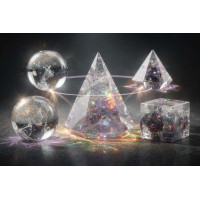
For all its virtues, a pure square has a weakness: it is static. Designers who work with symbolic geometry point out that squares alone are, frankly, a little boring, which is why the classic move is to marry the square with the triangle. Combine the four of the square with the three of the triangle and you get the pyramid, the shape traditions credit with concentrated, preserved, amplified power. The lesson generalizes beautifully: stability without dynamism becomes stagnation. A grounded life, like a compelling piece of jewelry, needs both the square's foundation and the triangle's upward fire. If your routines feel like a cage lately, the geometric diagnosis is not too much square, it is too little triangle.
Which Temperaments Resonate with the Square
In the tradition of matching shapes to the twelve zodiac signs, the square speaks most directly to certain temperaments. The earth signs, Taurus, Virgo and Capricorn, share the square's whole constitution: these are builders who feel safest with structure and become their best selves inside firm foundations. Cardinal signs, Aries, Cancer, Libra and Capricorn, who specialize in initiating projects, benefit from a square's anchoring presence once the launch energy needs somewhere stable to land. Fire and air temperaments, by contrast, may find a heavy square presence constraining rather than calming; tradition suggests they pair better with circles and spirals, or wear squares only during seasons when their abundant motion needs a container. As always in this tradition, these are resonances to experiment with, not rules to obey.
How to Wear Stability
Because the square's message is dependability, it makes a natural companion for turbulent seasons: a new job, a move, a stretch of uncertainty. Square-cut beads, rectangular pendants and cube-shaped stones carry the symbolism into daily wear, and tradition holds that the wearing position matters, the non-dominant wrist for receiving energy, the dominant side for projecting it. A grounded, wearable option is a geometric bracelet from Starener, where square-cut stones on a red cord combine the square's stability with the protective luck of red, two traditions reinforcing each other. Many people going through transition report that the small square on their wrist becomes a private signal: feet down, corners set, stand here.
A Three-Minute Grounding Practice with a Square Object
Take any square or rectangular object, a coaster, a book, a square-cut pendant, and hold it where you can see all four corners. Trace the top edge with your eyes as you breathe in; trace the opposite edge as you breathe out. Move corner to corner, four breaths for four corners, then hold the whole square in your gaze for two final slow breaths. The practice borrows the shape's symmetry to slow and steady the breath, and the mind tends to follow the breath. Three minutes is enough to notice the difference before a hard conversation or an uncertain meeting.
Frequently Asked Questions
What does a square symbolize spiritually?
Across traditions the square represents stability, the material world, and ordered foundations: the four elements, four directions and four seasons all live inside it. It is the geometric emblem of groundedness.
Which zodiac signs pair best with square shapes?
Earth signs, Taurus, Virgo and Capricorn, resonate most naturally, and cardinal signs benefit from squares when initiating projects. Fire and air temperaments traditionally pair better with rounder, more dynamic shapes.
Is the square considered sacred geometry?
Yes. Alongside the circle and triangle, the square is one of the foundational forms of sacred geometry, appearing in mandalas, temple plans and alchemical diagrams as the structure that contains and grounds spiritual energy.
Can wearing square shapes really change how I feel?
No shape is a cure for anything, and honest practitioners are clear about that. What many people find is that a meaningful shape worn daily works as an attention anchor, a small repeated reminder of the quality, here, stability, they are trying to practice. The reminder is the mechanism, and it is a real one.
Tags: square symbolism, geometric energy, stability, sacred geometry
Related Pieces
View All →
You May Also Like
All Articles →
This content is copyrighted by its original authors. In case of any infringement, please contact us for removal.
Comments
Write a comment