The Scratch Test: Reading Mohs Hardness Before You Commit a Crystal to Daily Wear (October 2026)
By Starener Editorial - 12/10/2026 - 0 comments
Every crystal shop has a moment that repeats itself: someone falls for a stone — its colour, its weight, the way it catches the light — and pictures it on their wrist every day for the next ten years. What the picture leaves out is physics. Some crystals shrug off decades of daily contact. Others, worn the same way, will collect scratches, lose their polish and look tired within a season. The difference is not mystical. It is measurable, it has a name, and learning it will save both your stones and your money.
Mohs 101: What the Number Actually Means
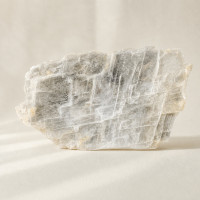
In 1812 the mineralogist Friedrich Mohs devised a scratch-based scale that still governs gemmology. It runs from 1, talc, to 10, diamond, where each mineral scratches everything below it and is scratched by everything above. Quartz family stones — amethyst, citrine, clear quartz, rose quartz, smoky quartz, agate, jasper — sit at 7. Moonstone runs 6 to 6.5. Turquoise 5 to 6. Fluorite 4. Selenite, the popular white cleansing stone, sits at just 2.
Two facts about the scale matter more than the numbers themselves. First, the steps are not even — the gap between 9 and 10 is far wider than the one between 5 and 6. Second, and most useful for daily life: the single biggest threat to a stone in your jewellery box is not the world outside. It is the other stones in the same box. Quartz at 7 will slowly scratch moonstone at 6.5, fluorite at 4 and especially selenite at 2, just by sharing a bowl with them.
Hardness Is Not the Whole Story: Meet Toughness
Gemmologists distinguish hardness — resistance to scratching — from toughness, resistance to breaking. A stone can be hard and brittle. Emerald is the classic case: at 7.5 to 8 it resists scratching admirably, yet its internal fissures make it fragile against knocks, which is why the emerald cut crops the corners that would chip first. Diamond itself, the hardest natural material, has four cleavage planes along which it can split cleanly if struck at the wrong angle.
Practical translation: hardness tells you how a stone ages against dust, skin and its shelf-mates. Toughness tells you how it survives desks, doorframes and gym sessions. Both matter, and they fail in different ways — one as a slow haze of fine scratches, the other as a single heartbreaking chip.
Matching Stone to Life
The rule of thumb used across the trade: stones at 7 and above handle rings, bracelets and everyday wear well. Stones between 5 and 7 do better in protected settings or in pieces that live away from impact. Below 5, most stones belong in pendants, earrings, display pieces or occasional-wear moments rather than on a working hand.
Consider three common choices for a daily ring. Amethyst at 7 takes ordinary daily contact comfortably, though a hard strike against stone or metal can still chip it. Moonstone at 6 to 6.5 is wearable but softer than quartz — a bezel setting, where a metal rim wraps the stone's edge, protects it from side knocks, and taking it off for gardening and cleaning keeps its glow. Turquoise at 5 to 6 is loveliest as a pendant or earrings; on a hand it will collect scratches and dull within a few years of daily wear.
The Bracelet Collision Problem
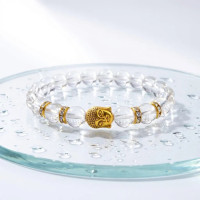
Bracelets deserve their own warning. A strand of quartz beads worn beside a strand of fluorite beads is a slow-motion accident — with every movement of the wrist the harder stone laps the softer one. The fix is either to choose beads of similar hardness for stacked wear, or to accept consciously that the softer strand will age faster than its neighbours.
Water, Sun and Chemistry: The Other Three Risks
Scratches are only one way a stone loses its life. Care guides across the trade repeat three more rules that daily wear puts to the test:
- Water: never soak selenite, which dissolves; lapis lazuli, malachite, pyrite and hematite also belong nowhere near water. Warm water and mild soap suit the quartz family, followed by a thorough dry.
- Sun: amethyst, rose quartz, citrine, smoky quartz and fluorite fade with prolonged bright sun. A windowsill charging session is fine; a sunny dashboard is not.
- Chemistry: perfume, hairspray and lotion go on first, jewellery second. Porous stones such as turquoise additionally dislike sweat, skin oils and cosmetics over time.
A Four-Question Check Before You Commit
Before a stone graduates from shelf to daily wear, run it through four questions. One: what is its Mohs number, and is it a range? Two: where will it live — hand and wrist take the most knocks, neck and ears far fewer, a display shelf almost none? Three: does it have known fragilities — cleavage, visible fractures, treatments — that a protected setting could cover? Four: how will it be stored, and what will it touch overnight? A stone that passes all four is genuinely ready for the long haul.
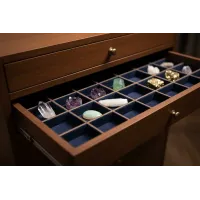
Storage deserves a sentence of its own, because it is where most damage actually happens. Individual pouches or a lined box with dividers keep the quartz family from sanding down everything softer. Chains clasped so they do not knot. Turquoise and other porous stones away from heat. Clusters and geodes lifted by the base, never by the points.
An Honest Word About the Energy Layer
None of this cancels the energetic meanings people cherish — tradition holds that amethyst calms, that rose quartz softens, that black tourmaline grounds. Practitioners are usually the first to say the two conversations answer different questions: what the stone means, and whether it survives. But the meanings only matter if the object lasts, and the object lasts only if its physics were respected. Choosing a moonstone pendant over a moonstone ring is itself a form of care for the stone's role in your practice — a stone that stays whole can stay in the ritual for decades.
If you are choosing a piece for daily wear, start from hardness, add a protective setting for anything under 7, and pick the colour you will actually wear with your wardrobe. When you want stones already matched to everyday wear — quartz-family pieces chosen with both meaning and durability in mind — you will find them at starener.com.
Frequently Asked Questions
Can I wear a Mohs 5 stone every day?
Yes, with design help. A protective bezel setting, a placement away from impact such as a pendant or earrings, and removal before rough work let softer stones live long lives. The mistake is not owning a soft stone; it is asking a soft stone to do a hard stone's job.
Why did my amethyst scratch even though it is a 7?
Hardness resists scratching, not breaking. A hard knock against stone or metal can chip any quartz, and household dust — which contains quartz particles at 7 — can slowly haze a polished surface over years. Gentle handling and a soft cloth after wear slow both processes dramatically.
Which crystals should never touch water?
The standard caution list includes selenite, which dissolves; malachite, which is unsafe when wet; and lapis lazuli, pyrite, hematite and angelite, which can rust, etch or crack. For these, use moonlight, a selenite charging plate kept dry, or sound as the cleansing method instead.
Does storing crystals together damage them?
Over time, yes. Harder stones scratch softer ones through simple contact. Separate pouches or a compartment-lined box keep every stone's finish intact, and they also stop chains knotting and points snapping off clusters.
Tags: Mohs hardness, crystal care, daily wear, crystal jewellery, durability
Related Pieces
View All →
You May Also Like
All Articles →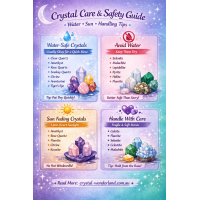
This content is copyrighted by its original authors. In case of any infringement, please contact us for removal.
Comments
Write a comment