Focus Crystals for Deep Work: A Desk-Stone Ritual for the Psychological Layer
By Starener Editorial - 19/07/2026 - 0 comments
A small stone on a desk is one of the oldest focus tools in human history. Scribes kept them; medieval monks kept them beside manuscripts; modern writers still reach for them. In the four-layer model of crystal energy — physical, psychological, symbolic and ritual — the desk stone belongs chiefly to the psychological layer: the calming and focusing effect that a tangible object has on a wandering mind. This article looks at the tradition honestly, names the stones most associated with focus, and offers a sixty-second ritual you can actually keep.
The Desk Stone: One of the Oldest Focus Tools Around
The mechanism behind the desk stone is behavioral, and practitioners who write about it are refreshingly candid about that. A consistent physical object on your work surface becomes an environmental cue for focus mode — the same way a specific seat, lamp or playlist can trigger task initiation. The stone does not sharpen your thinking on its own; what it offers is a deliberate pause at the boundary between “about to work” and “working.” For many people, that small, repeatable signal is genuinely useful, and the cue effect builds over weeks rather than minutes.
Four Stones for Four Focus Problems
Rather than asking which focus crystal is “most powerful,” tradition suggests identifying the mode your mind needs right now. One or two stones are enough; a desk crowded with crystals becomes decoration.
Fluorite: Order for Scattered Information
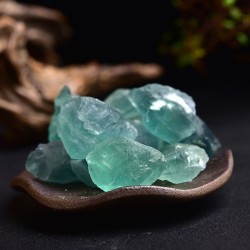
Fluorite is the classical study stone, so strongly linked with mental organization that scholars in China are said to have kept fluorite carvings on writing desks for centuries. Its banded layers — green, purple, clear — make it a natural symbol for sorting tangled information into order. Choose fluorite when the problem is structure: too many tabs open, too many threads, no hierarchy.
Clear Quartz: The Neutral Amplifier
When you are unsure which stone fits, clear quartz is tradition’s neutral companion — the amplifier that pairs with anything. Practitioners describe its role as amplifying whatever intention it sits beside, which makes it the safest first desk stone and a natural pairing with fluorite for study sessions.
Sodalite: Logic and Calm Problem-Solving
Sodalite, deep blue with white veining, is associated with rational thought and calm communication. It suits work where the obstacle is self-doubt rather than raw concentration — debugging, drafting, preparing to explain an idea out loud. Keep it in your sightline while working; a tumbled piece does the job without fuss.
Hematite: Grounding a Scattered Start
Hematite is linked with grounding and the physical body. Its weight gives a scattered mind something solid to notice — tradition reads this as an anchor that must be set before concentration can happen at all. Choose hematite when the problem is beginning: feet on the floor, stone in hand, one breath, then the next concrete action.
A 60-Second Desk-Stone Ritual
- Clear the field. Put away unrelated material and silence avoidable notifications. A stone competing with clutter for attention does little.
- Name the destination. Write one result you can complete or check this session — not the whole day’s list.
- Choose one stone. Fluorite or clear quartz for study, sodalite for logic, hematite for a scattered start.
- Hold it for three slow breaths. This is the actual ritual: the deliberate pause that separates “about to work” from “working.”
- Set it in the same spot each time. Consistent placement builds the cue faster than moving it around.
- Close the loop. Touch the stone again when you finish, and note what you learned and where to begin next time.
A Weekly Reset for Your Focus Stone
Stones that sit through dozens of stressful sessions can start to feel, in the language of practitioners, cluttered — the same way an inbox does. A short weekly reset keeps the ritual meaningful: a pass with sound (a bell or bowl works well, since a clear tone mirrors a clear mind), or an overnight rest on a selenite plate or in moonlight. Avoid soaking softer stones like fluorite and hematite in water; sound and moonlight are the safest, most reliable options.
Wear It Instead: Keeping the Cue in Your Sightline
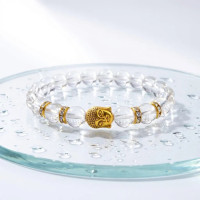
If your desk is shared, mobile or simply chaotic, the wearable version of the desk stone solves the placement problem: a crystal bracelet keeps the stone in near-constant contact and turns the cue into something you carry between meetings. Many people choose their focus stone as a bracelet precisely so the three-breath ritual can happen anywhere — before a presentation, an exam or a difficult call. If you would like a piece that pairs crystals with symbolic meaning, you can browse the Starener collection and pick the stone that matches the work you are doing this season.
Frequently Asked Questions
Do focus crystals actually work?
Not as a mechanism — no stone improves thinking on its own, and honest practitioners say so. What a stone offers is a ritual cue: a physical object that marks the start of focused work. For many people that repeatable signal is genuinely useful for settling into a task.
What is the best crystal for studying?
Fluorite is named most often, followed by sodalite for logic-heavy work and clear quartz as the all-purpose pairing. The stone that makes your mind feel a touch quieter when you hold it is the right place to start.
Can I use more than one focus stone?
One is usually better. A single specific object becomes the work cue; three or more turn the desk into decoration. If choosing among stones becomes a new distraction, simplify.
How do I cleanse a focus stone safely?
Sound and moonlight are the gentlest universal methods. Avoid soaking fluorite, hematite and selenite in water, and keep amethyst and fluorite out of long direct sunlight, which can fade their color.
Tags: focus crystals, fluorite, clear quartz, desk stone, crystal energy
Related Pieces
View All →



This content is copyrighted by its original authors. In case of any infringement, please contact us for removal.
Comments
Write a comment