Four Things I Believed About Chakra Energy for Years That Weren't True
By Starener Editorial - 02/11/2026 - 0 comments
Every few months, for years, I ran the same ritual: a "chakra cleanup day." I'd line up my books, do a meditation for each of the seven centers in order, declare myself balanced by dinner — and by Thursday I'd feel foggy again and assume I'd done it wrong. It took me an embarrassingly long time to notice the pattern wasn't in my execution. It was in what I believed chakra energy was for. Here are the four beliefs I've had to unlearn, one by one.
I thought chakras were spinning wheels I could almost see
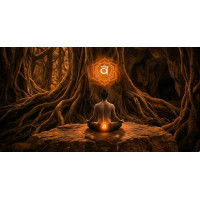
Early on, I treated the chakras like literal machinery — seven little turbines in my torso that I could rev up with the right meditation. What I've come to understand, from the older yogic sources and from my own practice, is humbler: in the subtle-body tradition, the chakras are centers of awareness, a felt map of what a person needs. Safety, desire, will, love, expression, insight, connection — mapped from the base of the spine to the crown. The classic seven-center model names them Muladhara (red, earth, safety), Svadhisthana (orange, water, emotion and desire), Manipura (yellow, fire, will and confidence), Anahata (green, air, love), Vishuddha (blue, sound, honest expression), Ajna (indigo, light, insight), and Sahasrara (violet or white, pure awareness, connection). Nothing to rev. Something to notice. The knotted stomach, the guarded chest, the words stuck in my throat — I was already feeling the map every day; I just hadn't learned to read it.

I thought "blocked" meant a chakra door I'd shut
I used to imagine chakras as doors: open or shut, and mine were mostly shut. The teachers I trust describe something more like a spectrum. A center can be underactive — shut down, avoidant, numb — or overactive, compensating, spilling over. An overactive throat talks over people; an underactive one can't say what it means. Neither is "closed." The best analogy I've found is the pupil of the eye, which opens and contracts from moment to moment depending on the light. That's why my Thursday fogs never meant failure — just a center adjusting to new weather. These days I ask "what is this center doing right now?" instead of "is this one open?" The answers are more useful and less dramatic.
I thought I could fix one chakra center alone
For about two years, my entire practice was "open the heart." I did heart-centered meditation daily and ignored everything else, and I couldn't understand why nothing shifted. The centers work as a system. In the tradition I study, the heart is the hinge between the three lower centers — the more physical needs of safety, desire, and will — and the three upper ones of expression, insight, and connection. A "closed" heart with an exhausted root is a house with a beautiful middle floor and no foundation. I eventually made more progress with one honest question — which two centers are asking for attention this week? — than with two years of solo heartwork. Balance, when I find it, is less a state than a flow I keep returning to.
I thought balance was permanent once achieved
This one cost me the most, because it turned every ordinary bad week into proof of failure. The honest version: chakra balance is maintenance, not a trophy. Like tuning an instrument, it drifts with stress, seasons, sleep, and grief, and returning to it is the practice — not a detour from it. My baseline has genuinely shifted over the years, but slowly, and only in step with actual changes in how I live, not from one dramatic "opening."
What changed after I unlearned all this? My cleanup days became cleanup minutes. Ninety seconds, morning: I scan for where I'm gripping, name the need behind it — safety, will, voice, whatever surfaces — and pick one small act that serves it. Some days it still doesn't work, and that's information too. The seven-stone bracelet on my wrist (picked out years ago at starener.com) isn't a fix; it's the cue that starts the scan. If you're curious, the practitioners at Starener describe it the same way I would now: a map, not a machine.
Questions people ask me about this
How do I know which chakra needs attention?
I match the theme, not the body part. Anxiety about money or belonging points me to the root; creative numbness to the sacral; a week of unsaid sentences to the throat. Notice which description of your recent life lands — that's usually the center asking.
Can a crystal or a healer open a blocked chakra for me?
In my experience, no object does the work for you — but objects cue the work. My bracelet is a reminder, not a remote control. What actually shifts things is the small, repeated returning: the scan, the named need, the one act.
How long until I feel balanced?
Shorter than I feared and slower than I hoped. Some practices settle me in minutes; the deeper patterns took seasons. I'm not a doctor, and this isn't medical advice — just what my notebook shows after several years of entries.
Tags: chakra myths, chakra energy, chakra balance, seven chakras
Related Pieces
View All →



This content is copyrighted by its original authors. In case of any infringement, please contact us for removal.
Comments
Write a comment